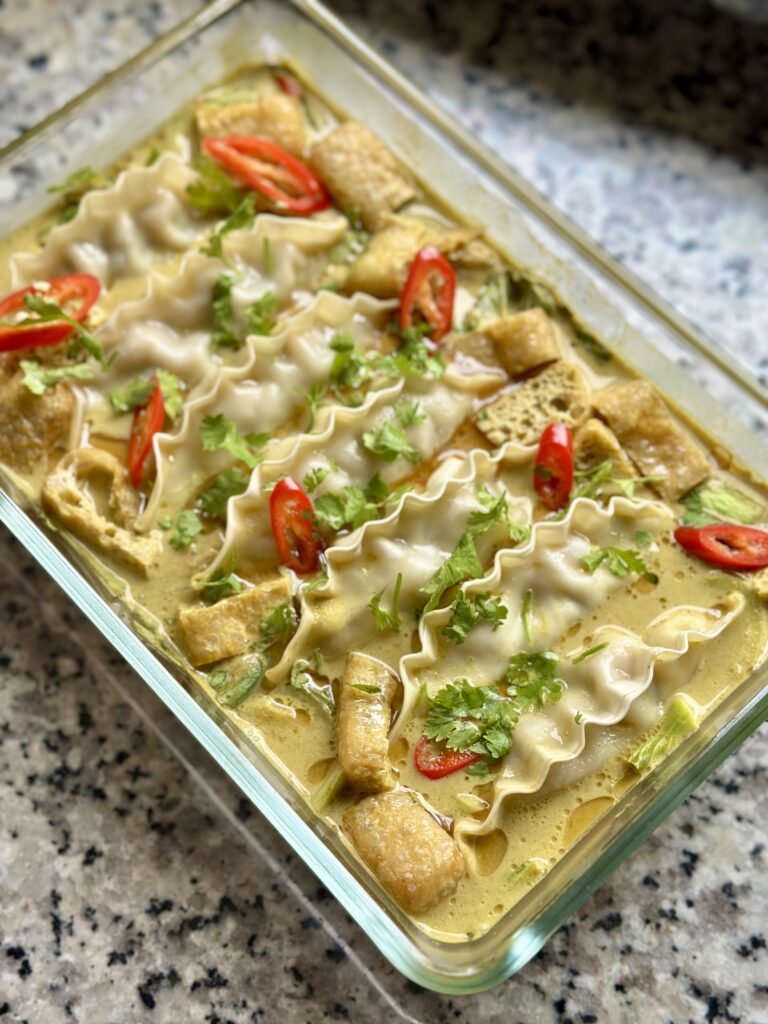
This viral one-pan recipe includes vegan dumplings baked in an aromatic, rich, creamy laksa broth packed with flavour.
These one-pan baked dumplings are life changing – it requires little to no prep while also being versatile enough for you have a balanced meal. Add any veggies, mushrooms or protein you like so it’ll cook in the flavourful laksa broth. Top it with red chilies and coriander for the perfect addition of spice.
I paired these brothy dumplings with air dried ramen noodles, but you can also have them with rice noodles or rice. If you’ve craving something hot and soup-y, you can add a splash of water to have this dish like a dumpling soup.
The viral recipe uses laksa paste and coconut milk for the base – so all you have to do it mix it together with coconut milk in the oven dish, add garlic, soy sauce, lime juice – and you’re good to go!
Ingredients You Need
frozen vegan dumplings – you can use any frozen vegan dumplings for the recipe. Something with a neutral filling is preferred so it goes well with the broth!
additional ingredients – tofu puffs, bok choy, mushrooms of choice
laksa paste – ensure that it’s vegan! Laksa pastes usually contain shrimp paste.
aromatics – minced ginger, red chilies
coconut milk – full fat coconut milk is not necessary as we don’t need the base to be thick.
sauces and seasoning – soy sauce
garnish – red chilies, coriander
Gluten free substitutions: Gluten free rice paper dumplings would work for this recipe. Ensure you use gluten free soy sauce and laksa paste.
Allium free substitutions: Use allium free frozen dumplings and omit garlic.
This viral one-pan recipe includes vegan dumplings baked in an aromatic, rich, creamy laksa broth packed with flavour.
Prep Time10 minutesmins
Cook Time20 minutesmins
Total Time30 minutesmins
Course: Main Course, Soup
Cuisine: Asian
Keyword: dumplings, soup
Servings: 4
Ingredients
1.5tspminced garlic
2-3tbspvegan laksa paste
1/2tbsplime juice
2tbsplight soy sauce
200mlcoconut milk
2.5cups water
10frozen dumplings
2stalksbok choy
1cuptofu puffs
2red chilies
2tbspchopped coriander
4servingsnoodles
Instructions
Preheat oven to 400°F (200°C).
Add minced garlic, laksa paste, lime juice and soy sauce to an oven dish. Stir until combined.
Pour in the coconut milk and stir until smooth. Add water and whisk well. Add a pinch of turmeric for color if required.
Add chopped bok choy and tofu puffs.
Nestle frozen dumplings into the sauce in a single layer. Spoon some of the sauce over the tops to coat slightly.
Transfer the pan to the oven and bake for 20 minutes, or until the dumplings are heated through and the sauce is bubbling and slightly thickened.
Remove from oven and top with red chilies and chopped coriander. Serve hot, straight from the pan. You can spoon some broth, dumplings and topping over cooked noodles, mix and serve! Enjoy.
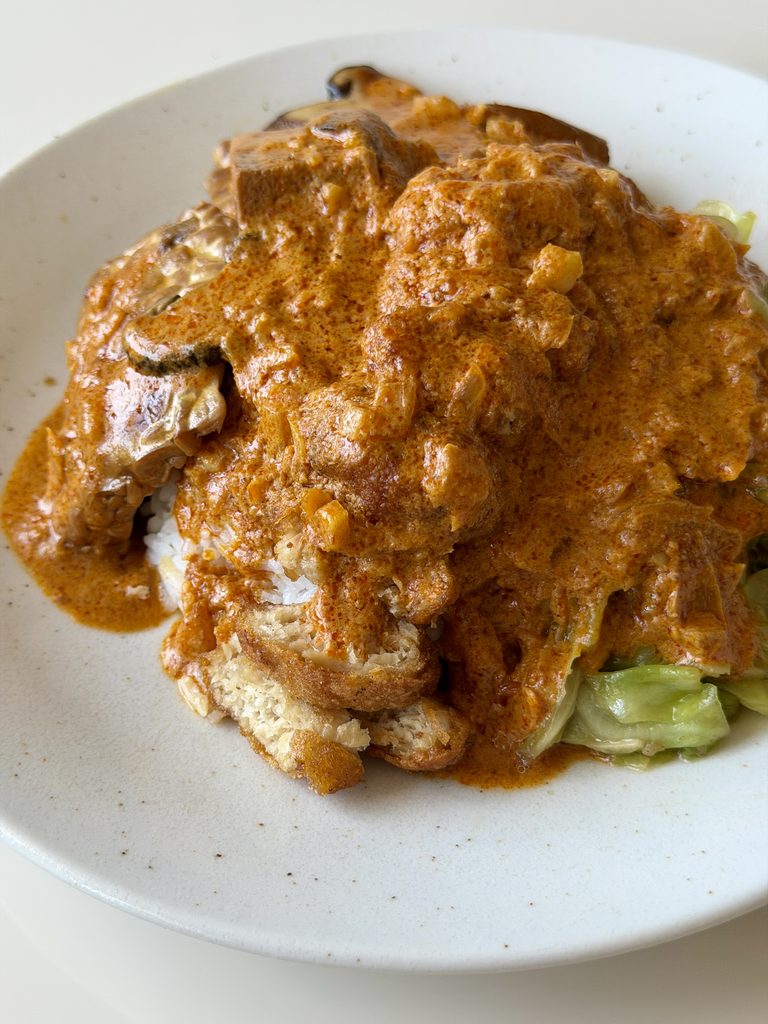
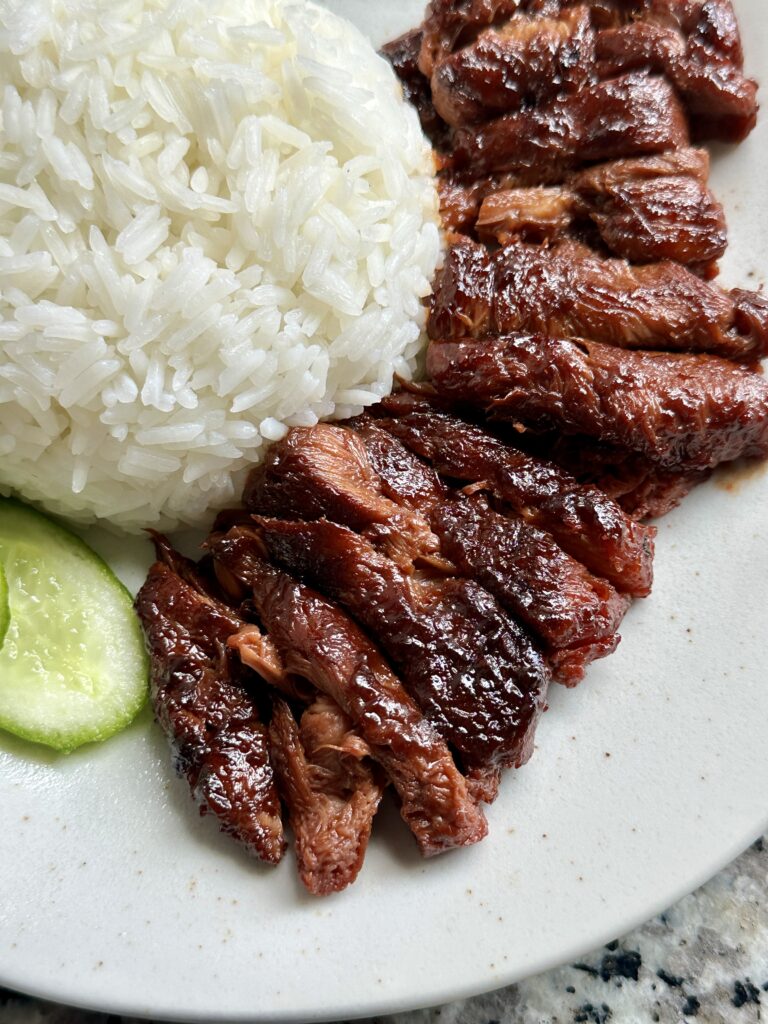
This char siu ‘pork belly’ made with lion’s mane mushrooms is succulent, full of flavour and tastes almost exactly like the traditional version! Served with rice and crisp cucumbers.
Char Siu (Chinese BBQ pork), a beloved dish in Chinese cuisine known for its sweet, savory, and slightly smoky flavor. Even though as a child I was not allowed to consume pork due to religious reasons (on hindsight it was not entirely just religion – it was a health concern too), I still found myself sneakily trying a plate of Char Siu Rice at the hawker centre just 5 minutes away from my home.
The beauty of the dish lies in the smokiness and sweetness that comes together with a drizzle of sauce and fresh steamed hot rice. Char Siu is traditionally made with pork, often pork belly, and roasted to create a tender, caramelized outer layer. Char siu refers to barbecued pork and directly translates to “fork roast” in Cantonese, referring to the traditional method of skewering the pork and roasting it over an open flame.
Once I turned vegan, the only Char Siu substitutes were ultra processed, ‘red-looking’ soy meat that was far from juicy. So I turned to the plant based saviour that soaks in flavours like a sponge while retaining the chewy texture: lion’s mane mushrooms.
Lion’s mane is making its way round the health and wellness community with its potential cognitive and immune-boosting properties, but it’s been a really common plant based substitute in many vegetarian restaurants in Singapore and Asia. Eating them whole is a fun way to substitute meat in many recipes.
Their meaty, slightly fibrous texture gives them the perfect opportunity to be in place of meats like chicken, pork and beef. Marinating them in a flavourful Char Siu glaze gives them a rich and smoky flavour. Whether you’re roasting, grilling, or pan-frying, you can achieve a crispy caramelized exterior while keeping the inside moist and succulent.
Ingredients You Need
lion’s mane ‘steaks’ – get large lion’s mane mushrooms. I get mine from Mushroom Buddies
char siu marinade – we need a balance of sweet, salty, savoury, and smokey flavours
vegan hoisin sauce
light soy sauce, dark soy sauce
chinese five-spice powder
agave syrup
fermented red beancurd (this is KEY for the flavour + red colour!) – if you’re unable to find this, you can use red miso
vegan oyster sauce
shaoxing wine – chinese cooking wine
sesame oil
white pepper
minced garlic
beetroot juice (for colour) – you can also use beetroot powder or dragonfruit powder
pinch liquid smoke
steamed rice
asian greens of choice – bok choy, kailan or kang kong (water spinach)
crisp cucumbers
Allium free substitutions: Omit minced garlic in marinade and substitute with asofoetida (hing).
This char siu 'pork belly' made with lion's mane mushrooms is succulent, full of flavour and tastes almost exactly like the traditional version! Served with rice and crisp cucumbers.
Prep Time30 minutesmins
Cook Time30 minutesmins
Total Time1 hourhr
Course: Main Course
Cuisine: Asian, Chinese
Keyword: lion’s mane mushroom, mushroom recipes, pork belly
Servings: 4
Ingredients
2largelion's mane steaks or 4 smaller ones
1/2tsp5-spice
1/4tspwhite pepper
1tsptoasted sesame oil
2tspminced garlic
1tbsp vegan hoisin sauce
1tbspvegan oyster sauce
1tsplight soy sauce
1tbspshaoxing wine
2tspred fermented bean curd
1tbspagave / maple syrup / coconut sugar
1/4cup water
1/4cup beetroot juice
pinchliquid smoke
neutral oil for frying
Serving
4servingswhite rice
cucumbers
asian greens of choice
Instructions
Clean the mushrooms by gently wiping them with a damp cloth (avoid rinsing under water as they absorb moisture easily).
In a large bowl or tupperware, whisk together the ingredients for the marinade.
Place the mushroom steaks in, cover with a lid and shake to get the marinade evenly coated on mushrooms.
Let the mushrooms marinade for at least 30 minutes – you can marinate them for longer for a deeper flavour or even overnight. Flip the tupperware halfway to ensure even coating.
Heat oil in a large pan over medium-high heat. Once hot, add the marinated mushroom onto pan. After a minute, place a heavy lid on the mushrooms to press them down to get a 'steak' like appearance.
Pan fry them for 4-5 minutes on each side until golden brown and slightly seared around the edges. While cooking, spoon some of the leftover marinade over the mushrooms to glaze them
Slice the mushrooms. Serve them alongside a bed of white rice, cucumbers and greens. Enjoy!
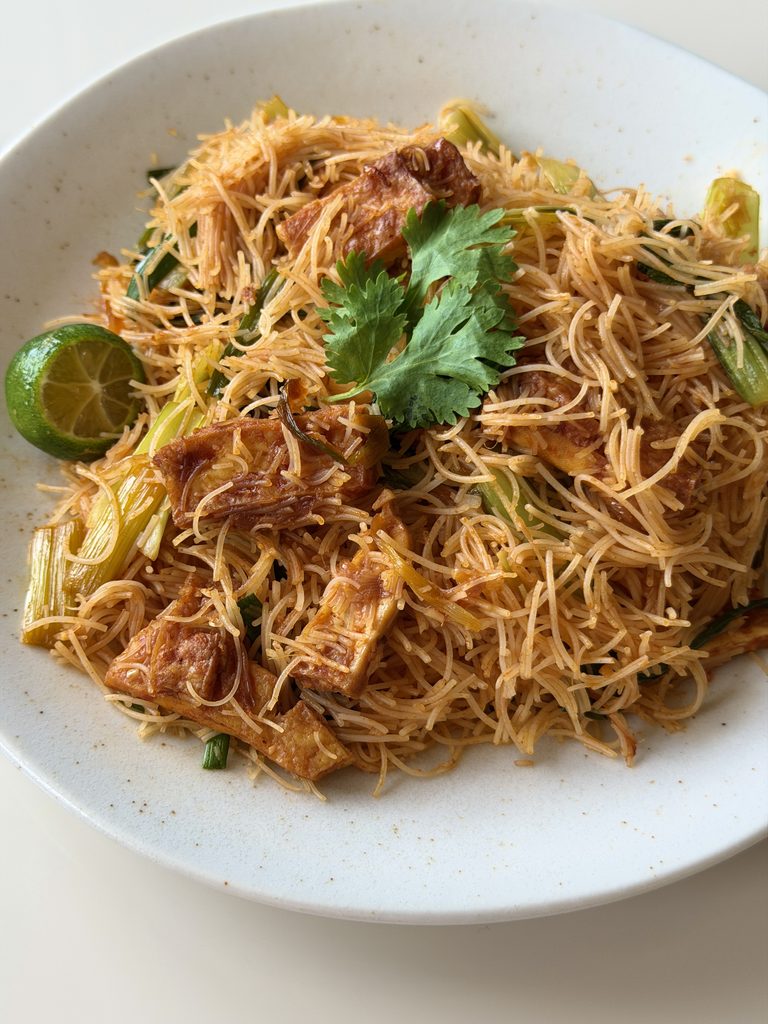
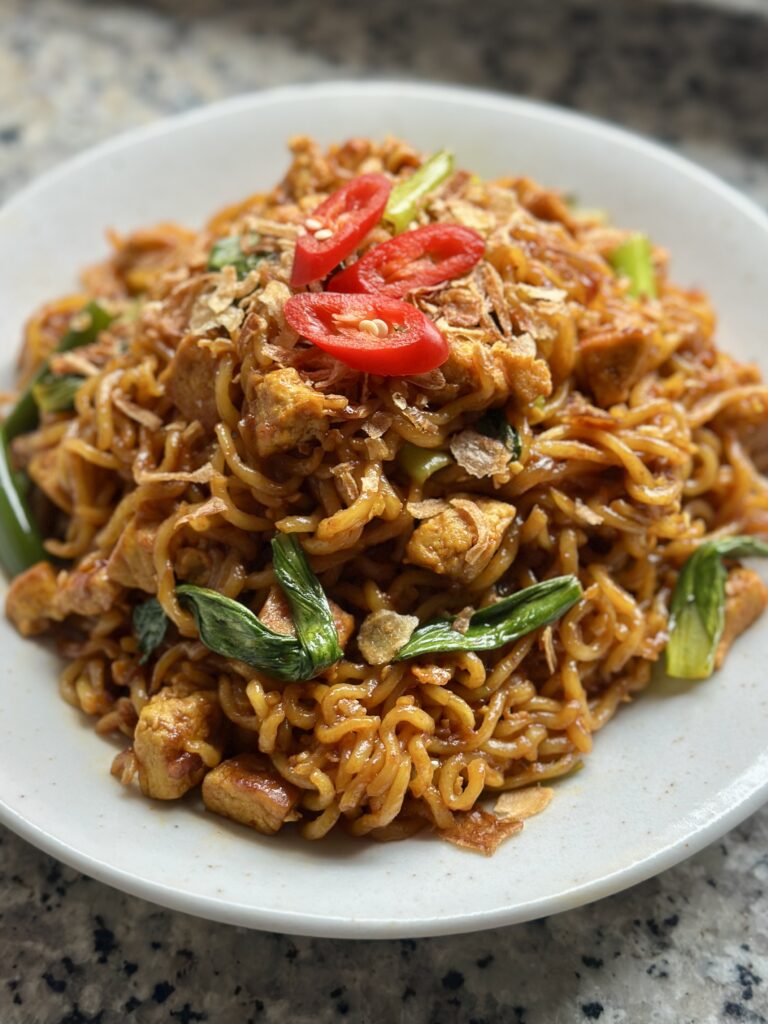
This famous hawker-style dish is made with noodles stir fried with tofu, vegetables, and fresh aromatics. Perfect for a quick and easy meal.
If cooking seems complicated to you, you are at the right place – I’m here to show you that vegan cooking is more EASY than you think! This popular street food stirfry noodle dish – also known as Maggi Goreng – is one of my favourite ways to clear out leftover vegetables, protein and use instant ramen noodles.
“Maggi” obviously means noodles but can also be named “mee” to refer to yellow noodles. “Goreng” means “fried,” so it directly translates to “fried noodles”.
Here are some easy pointers to make this delicious and easy spicy fried noodles:
Use maggi noodles or instant leftover ramen for the perfect noodle stirfry that’s also healthier as we’ll be ditching the seasoning that comes with it. You can also use fresh noodles.
Some of my favourite vegetables to add to fried rice are kailan, bok choy, kale, carrot, corn and long beans. Depends on what I have in my fridge but this recipe only includes tofu and bok choy.
To make this recipe gluten free, substitute the soy sauces with a gluten free version like tamari or coconut aminos. There are also gluten free soy sauces available (look for ones without wheat in them).
Ingredients You Need
noodles – ramen noodles are perfect but you can use any type of noodles.
aromatics – shallots, garlic, red chilies (use the small ones for more spice – I used the large one) and scallions
kecap manis – this sweet soy sauce is a signature component of maggi goreng. It adds a rich sweetness to the dish. However, the version I used is not gluten free – you can substitute this with soy sauce and a pinch of agave.
vegetables – common vegetables include carrots, peas, green onions, and cabbage. Here, I used kailan or bok choy.
garnish – fried shallots, lime and red chilies.
Gluten free substitutions: 1 tsp kecap manis = 1 tsp gluten free soy sauce + 1/2 tsp agave. You can also use tamari or coconut aminos. Use gluten free soy sauce in place of dark soy sauce as well. If using vegan shrimp paste, ensure it’s gluten free. In place of that, you can use sambal paste too.
Allium free substitutions: Omit garlic, shallots/red onion, and scallions. Instead use a pinch of asafoetida in the sauce. Substitute green part of scallions for coriander for garnish. Omit fried shallots. Ensure sambal paste is allium free.
This famous hawker-style dish is made with noodles stir fried with tofu, vegetables, and fresh aromatics. Perfect for a quick and easy meal.
Prep Time10 minutesmins
Cook Time10 minutesmins
Total Time20 minutesmins
Course: Main Course
Cuisine: Indonesian, Malaysian, Singaporean
Keyword: hawker, noodles
Servings: 2
Ingredients
Maggi Goreng
2largenoodle cakesor 3 small ones
2servingsbok choy or other asian greens
200gextra firm tofu
1shallot
3clovesgarlicminced
2tspcurry powder
3green onionsgreen and white parts
2tbspolive oil
Sauce
1tbspkecap manis
1tbsplight soy sauce
1/2tbspdark soy sauce
1tbspvegan oyster sauce
2tbsptomato ketchup
1tspsambalmore if you want it more spicy!
1tbsptoasted sesame oil
Garnish
fried shallots
red chilies
Instructions
Boil instant ramen noodles for 1-2 minutes (slightly undercooked), then drain and rinse with cold water to prevent sticking.
Mince garlic and chop shallots, spring onions and bokchoy. Pan fry tofu until brown.
Mix together all sauces – kecap manis, light soy sauce, dark soy sauce, vegan oyster sauce, ketchup, sambal & toasted sesame oil in a small bowl.
Heat oil in a wok over medium-high heat. Sauté shallots, white part of scallions until fragrant. Then, add minced garlic, curry powder and saute for a minute.
Add back in tofu, noodles, sauce and mix well. Lastly, add bok choy and toss until cooked.
Top with more green onions, fried shallots, and a squeeze of lime. Enjoy!
This traditional black tea is pulled with sweetened vegan condensed milk and dairy-free milk to create a sweet, frothy and creamy tea.
Teh Tarik is a beloved traditional Malaysian and Singaporean drink made from strong black tea, sweetened condensed milk, and evaporated milk, which is “pulled” (or “tarik”) to create a frothy, smooth texture.
The name “Teh Tarik” literally translates to “pulled tea”, as it points to the method of making it – which includes a dramatic pouring and stretching process that creates foam, froth and a smooth texture.
The drink is especially popular in mamak stalls (open-air cafes run by Indian Muslim traders) where it’s served alongside traditional Malaysian food. It’s commonly enjoyed during breakfast, after meals, or as an afternoon pick-me-up, often served with roti canai (Indian flatbread).
How Teh Tarik Is Made:
Screenshot
The Tea Base
Traditionally, strong black tea (often a blend of Ceylon or Assam tea) is brewed. The tea is steeped until it is rich and robust, as the drink needs a strong base to stand up to the sweetness of the milk.
Sweetened Milk
A generous amount of sweetened condensed milk is added to the tea, giving it sweetness and a creamy texture. Hence, there is no other sweetener added. For a plant based version, I used sweetened oat condensed milk by Nature’s Charm (not affiliated). They also have a vegan evaporated milk that you can for extra richness – but this recipe doesn’t include it.
The “Pulling” Process
This is the signature step where the tea and milk mixture is poured back and forth between two cups at a high height. This helps to mix the tea and milk thoroughly while also creating the characteristic froth and smoothness.
The pulling also cools the tea to a drinkable temperature while enhancing its texture, making it rich and velvety.
Screenshot
Ingredients You Need
black tea leaves – you can use regular black tea, ceylon or assam blends.
vegan sweetened condensed milk
rich plant milk – oat milk barista blend is a great option (for gluten free, use gluten free oat milk or other milks like cashew or soy)
This traditional black tea is pulled with sweetened vegan condensed milk and dairy-free milk to create a sweet, frothy and creamy tea.
Prep Time5 minutesmins
Cook Time5 minutesmins
Total Time10 minutesmins
Course: Drinks
Cuisine: Malaysian, Singaporean
Keyword: drinks, tea
Servings: 2cups
Ingredients
4heaped tspblack tea leaves
1.5cupswater
1cupbarista grade oat milk
3tbspvegan condensed oat milk
Instructions
Start by brewing fresh black tea leaves in 1.5 cups water. Bring to a boil and add in oat milk. Let it simmer for about 5 minutes.
Strain out the tea leaves using a sock filter and keep the hot tea aside.
Add sweetened condensed milk to a cup. Carefully pour the tea from one mug to the cup with the condensed milk. Mix well with a spoon.
Get a traditional teh tarik kettle and pour the tea into the kettle. Hold the kettle and the cup at opposite ends and pour in ascending height so the tea mixes well and a frothy head forms.
You would need to repeat this process around 5 times to create the signature froth and to cool the tea down to a drinkable temperature.
Pour the tea into a glass, with a nice frothy top.
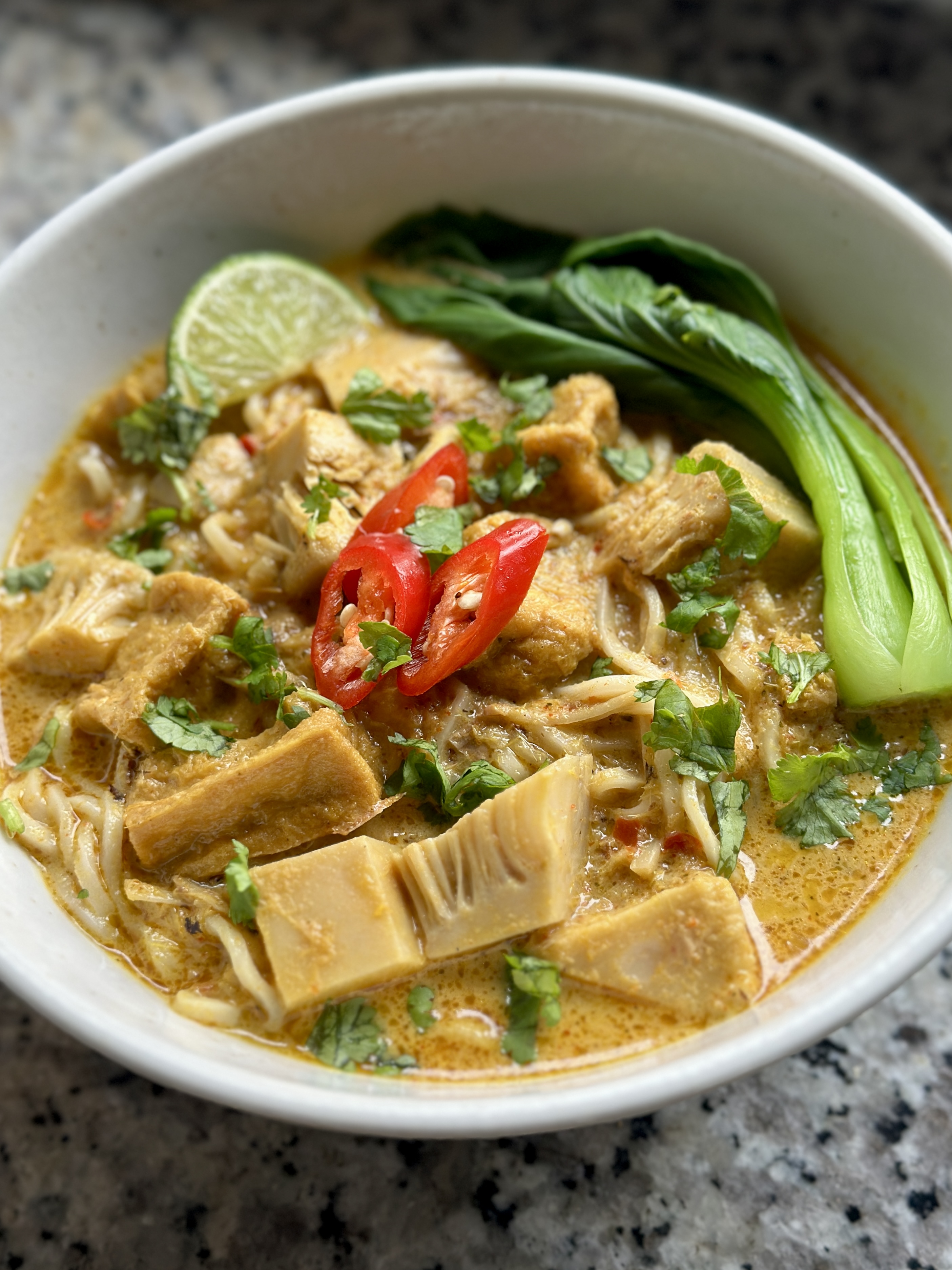
This jackfruit laksa dish drenched in a spicy, flavourful coconut curry is an Asian delicacy that’s truly addictive! It’s vegan AND gluten free.
This spicy noodle dish always reminds me that asian food is like a melting pot of different cultures. The ingredients used are so similar to other curries, yet depth and type of flavours are so different.
I grew up having this in Singapore and it’s one of the most flavourful noodles dishes you can have. It basically comprises thick rice vermicelli noodles doused in a fragrant and umami coconut curry broth. It’s usually topped with fresh herbs and spices. Truly so addictive!
Laksa is native to Malaysian & Singaporean cuisines so you can easily get this dish here. However, it’s slightly more challenging to find a vegan version of this dish. This is because the traditional version contains shrimp paste so in this recipe, I veganized it very easily by omitting it!
I can’t find all the ingredients in my grocery store…what do I do?
While I do recommend making the Laksa paste from scratch, for an easier foolproof version, use store bought Laksa Paste. I love this vegan, gluten free and organic one by Mekhala’s Living. You just need to use 2-3 tablespoons for immense flavour (not an affiliate – I’ve tried and tested this brand on my own accord).
I also used Canned Jackfruit for this recipe which works perfectly fine! The jackfruit is unripe so it’s flaky when pulled apart – however, we can just cut the jackfruit up into pieces for this recipe. I get mine from Nature’s Charm.
What You Need
thick rice vermicelli noodles – or you can substitute this with any noodles you like based on convenience
aromatics – shallots, garlic cloves, lemongrass (white part only), kaffir lime leaves, galangal or ginger, limes, dried red chili
dry spices – coriander powder, cumin powder, chili powder, turmeric
broth base – full-fat coconut milk
seasoning – gluten free soy sauce
toppings – baked jackfruit, tofu puffs
garnish – bok choy, tofu puffs sliced, red chili, coriander
Gluten free substitutions: This recipe is naturally gluten free! Make sure to use gluten free soy sauce.
Allium free substitutions: Omit shallots and garlic. Instead soak 5 candlenuts in boiling water and add it to the laksa paste.
This jackfruit laksa dish drenched in a spicy, flavourful coconut curry is an Asian delicacy that’s truly addictive! It’s vegan AND gluten free.
Prep Time20 minutesmins
Cook Time20 minutesmins
Total Time40 minutesmins
Course: Main Course, Soup
Cuisine: Malaysian, Singaporean
Keyword: laksa, noodle soup, noodles
Servings: 3
Ingredients
Homemade Laksa Paste
4shallots
4garlic cloves
3lemongrass stalks (parts with purple insides)
6kaffir lime leaves
thumbsizedgalangal
1tsplime zest
3-4dried red chili
1tspcoriander powder
1/2tspcumin powder
1tspchili powder
1/2tspturmericadd more for colour if necessary
Laksa Broth
1tbspneutral oil or olive oil
400mlcoconut milk
500ml water
1tsplime juice
1tbspgluten free light soy sauce
salt
1can young green jackfruit
Toppings
3servings thick rice vermicelli noodles
bok choy
tofu puffs
sliced red chili
coriander
lime wedges
Instructions
Preheat the oven to 200°C (400°F).
Drain and rinse the jackfruit, and cut into smaller pieces. Spread the jackfruit evenly on a baking sheet lined with parchment paper. Drizzle some olive oil and mix well.
Bake for 20-25 minutes, flipping halfway through, until the jackfruit is golden and slightly crispy. Set aside.
Slice the ends of the lemongrass until you no longer see a purple tint on the insides.
De-seed the dried red chilies. Soak them in hot water for about 10 minutes. Alternatively, you can boil them for a few minutes.
Add the ingredients needed for the paste into a blender. You can chop them up into smaller pieces for easier blending or you can blend them whole. When adding the kaffir lime leaves, tear them into half along the stem to enhance the aroma.
Add oil to pan. Add the curry paste and saute until fragrant (one way to identify this is to see if the oil you added is coming to the top of the paste).
Add water, coconut milk and mix well. Add soy sauce, salt and pepper as needed. Bring to a boil.
Add your tofu puffs, baked jackfruit and bok choy. Cook them for a few minutes until the bok choy or greens are bright green. Turn off the heat.
Cook your rice noodles according to the packaging instructions.
Assemble the noodles in a bowl, add your laksa broth and top with coriander, lime and red chili.
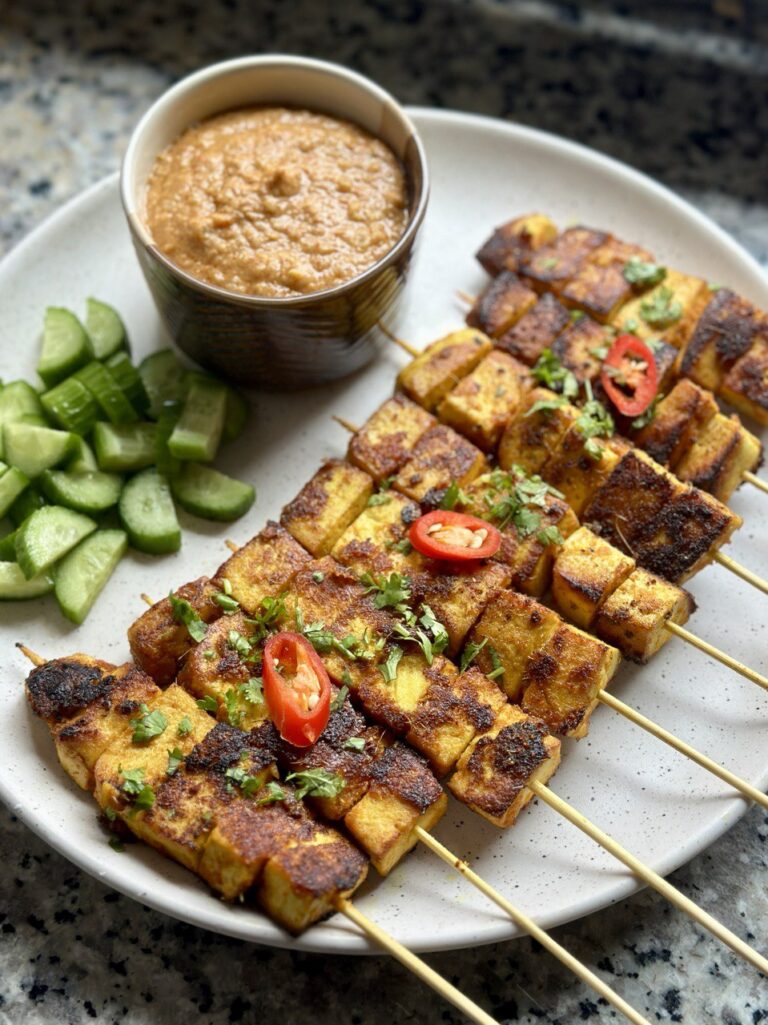
The best plant based, high protein satay – marinated tofu on skewers pan fried and served with a sweet and spicy peanut sauce!
The origins of satay are often debated, but this recipe is inspired by the satay dishes I grew up eating in Singapore – marinated spiced skewers served with a delicious and fragrant peanut sauce.
From its Indonesian and Malaysian roots, satay spread to Singapore. In Singapore, satay is often served as part of our hawker center offerings and is an integral part of the country’s street food culture. The skewers also tend to be smaller and can be purchased in bigger quantities. The peanut sauce is always also served generously.
Satay was one of my favourite foods since young – I grew up having the skewers with a delectable peanut sauce I could never get enough of. It’s savoury, sweet and slightly spicy with coarse but soft peanut bits. You can also make this as a smooth and creamy dip, but this is the way I’ve always had it and for some reason, it tastes so much more delicious! You can find my Peanut Satay Sauce Recipe here.
What Do I Need?
extra firm tofu
lemongrass – only the stalk which consists of purple interior
aromatics – garlic and shallots
dry spices – turmeric, coriander, chili powder
sweetener – palm sugar, coconut sugar or gula melaka syrup
salt
Gluten free substitutions: This recipe is naturally 100% gluten free!
Allium free substitutions: Omit shallots and garlic. Instead add about 5-6 soaked candlenuts and a pinch of hing (asafoetida) to blend.
The best vegan satay – marinated tofu on skewers pan fried and served with a sweet and spicy peanut sauce!
Prep Time30 minutesmins
Cook Time15 minutesmins
Total Time45 minutesmins
Course: Appetizer, Main Course
Cuisine: Indonesian, Malaysian, Singaporean, Thai
Keyword: dips, tofu recipes
Servings: 4
Ingredients
450gextra firm tofu
3tbspolive oil
more olive oil for frying if required!
3lemongrass stalks
3garlic cloves
6shallots
1tspturmeric
1tspcoriander powder
1tspchilli powder
1tbsp palm sugar
1.5tspsalt
Instructions
Drain extra firm tofu of water by patting both sides dry with a paper towel. Cut them into cubes.
Prepare the marinade: In a high speed blender or grinder, combine lemongrass, garlic, shallots, turmeric, coriander, palm sugar and salt. Blend until you get a smooth paste.
Add the tofu cubes to the bowl and mix to coat evenly. Cover and refrigerate for at least 30 minutes, but you can also let them marinate overnight.
To a pan, add 3 tbsp olive oil. Panfry tofu on all sides until crispy. You can also bake or air fry them at 200C for 15-20 minutes, flipping them halfway.
Serve satay with peanut sauce, lime wedge, and cucumbers. Garnish with chopped coriander and chilies. Enjoy!
A vegan version of the classic prawn paste chicken, this fried tofu tossed in a vegan sambal shrimp sauce is one you’ll be making for a delicious side dish!
Har Cheong Gai, also known as prawn paste chicken, is a popular dish in Cantonese cuisine – it traditionally features chicken marinated in a mixture of prawn or shrimp paste (har cheong), seasonings and spices, then coated in an umami batter and deep-fried to perfection.
Today, we’ll be recreating these flavours with extra firm tofu to make the crispiest and most delicious “prawn paste” tofu! The result is a crispy, savoury treat with an unforgettable umami kick. You can also use alternative plant-based protein ‘chicken’ pieces or seitan to replace the tofu.
Ingredients You Need
vegan shrimp paste or sambal belacan – I got a vegetarian sambal belacan here!
Alternatively if you want to make your own umami prawn paste at home, gather these:
miso paste
light soy sauce (gluten free if required
liquid smoke
ginger powder or grated ginger
nutritional yeast
sesame oil – for the fragrant marinade
shaoxing wine – substitute with rice vinegar or mirin!
white pepper – this has a sharper and aromatic than black pepper
sweetener – to balance out the spiciness
all-purpose flour – you can use a gluten free flour blend instead if you’re gf
corn starch – to add crispiness
baking powder
plant milk – gluten free oat milk or soy milk works great
corn starch slurry – to make a sauce out of the remaining marinade!
A vegan version of the classic prawn paste chicken, this fried tofu tossed in a vegan sambal shrimp sauce is one you'll be making for a delicious side dish!
Prep Time20 minutesmins
Cook Time20 minutesmins
Total Time40 minutesmins
Course: Appetizer, Main Course
Cuisine: Chinese, Fusion, Singaporean
Keyword: tofu, tofu recipes
Servings: 4
Ingredients
Marinade
300gextra firm tofu
2tspvegan shrimp paste
1tspsweetener
1.5tbspsesame oil
2tbspshaoxing wine
1/2tspwhite pepper
Umami Batter
3/4cup all-purpose flour
2tbspcorn starch
1tspbaking powder
1tspmushroom seasoning
1tsp 5-spice powder
1tspsalt
1/2cup cold oat milk or any other neutral unsweetened plant milk
If using tofu, press it to remove excess moisture, then cut it into bite-sized pieces. If using a plant-based chicken substitute, cut it into pieces that mimic traditional chicken sizes.
To make your own shrimp paste, combine miso paste, soy sauce, liquid smoke, grated ginger, and nutritional yeast in a bowl. Mix until well combined. This mixture will add great depth and umami.
In a bowl, mix shrimp paste, shaoxing wine, sesame oil, sweetener and white pepper. Add the tofu or plant-based chicken pieces and toss to coat. Let it marinate in the refrigerator for at least 20 minutes to absorb the flavours.
In a separate bowl, whisk together flour, corn starch, baking powder, mushroom seasoning, 5-spice and salt.
Gradually add cold plant milk, whisking continuously to create a smooth batter.
Heat vegetable oil in a deep pan or fryer to 350°F (175°C). The oil should be enough to submerge the pieces for even frying.
Dip each coated piece of tofu or plant-based chicken into the batter, ensuring it's fully covered. Carefully drop the battered pieces into the hot oil. Fry in batches, being careful not to overcrowd the pan.
Cook until golden brown and crispy, about 3-5 minutes per batch. Use a slotted spoon to remove the pieces and drain them on paper towels.
With the remaining marinade, add it into a pan with corn starch slurry. Add more vegan prawn paste and sambal paste if required and for more spice. Thicken the mixture over the stovetop.
Pour the sauce over the tofu and toss to coat evenly. Alternatively you can serve the fried tofu as a dipping sauce as well. You can serve this with piping hot rice. Enjoy!
This classic Singaporean adapted Chinese dish is salty, creamy and slightly sweet with bursting flavours from curry leaves and chillies – and it’s vegan!
The sensation that introduced the flavours of salted egg in Singapore was the salted egg yolk bao – countless people were posting the oozing molten custard on socials which is how I got to know the dish. Traditionally, the bao (steamed bun) is filled with molten custard made from butter, condensed milk and salted egg yolk. The flavours are salty, sweet and addictive!
Sooner or later, the salted egg yolk flavour was infused into almost everything – from crisps to croissants. I remember not leaning into the hype but once I tried a salted egg yolk bao, my life transformed. Not being dramatic here, but something about this savoury creamy sauce was very delicious.
Once I turned vegan, I couldn’t have it of course but salted egg yolk dupes in restaurants never quite met the mark. In this simple recipe, we will be recreating Singapore’s famous salted egg yolk chicken but with fried tofu. It’s made with simple ingredients but the flavours come together really well. No yolks used here!
Ingredients You Need
extra firm tofu – this replaces the chicken and is a rich source of plant based protein.
corn starch – this helps to make the tofu crispy and fun to eat!
seasonings – garlic powder, salt, white pepper
vegan butter – this gives a buttery flavour and adds to the creaminess
garlic – definitely be generous with the garlic! There’s huge flavour that comes from this
nutritional yeast – for the cheesiness. This is a staple in vegan cooking so you can use this in many recipes to get your dose of Vitamin B12.
curry Leaves – this is a MUST for the aroma
red chilli – one or two depending on the spice level you can tolerate
coconut cream – for the creaminess (I swear you can’t taste the coconut!)
oat milk – to add some texture to the sauce
Alliums free substitutions: Omit garlic powder and garlic. Instead, add a pinch of hing to the tofu fry batter and the vegan salted egg yolk sauce. Add an extra chili for more flavour.
Gluten free substitutions: Use a gluten free soy sauce / tamari / coconut aminos instead of soy sauce. Use soy milk or cashew milk instead of oat milk (or gluten free oat milk). Ensure vegan butter is gluten free.
This classic Singaporean adapted Chinese dish is salty, creamy and slightly sweet with bursting flavours from curry leaves and chillies – and it's vegan!
Prep Time20 minutesmins
Cook Time10 minutesmins
Total Time30 minutesmins
Course: Main Course, Snack
Cuisine: Chinese, Fusion, Singaporean
Keyword: tofu, tofu recipes, vegan egg
Servings: 4
Ingredients
2cubestofu (chunked)350-400g
1/4 tspsalt
1/4tspwhite pepper
1tsp garlic powder
3-4tbspcorn starch
neutral oil for frying
Salted 'Egg Yolk' Sauce
2tbspvegan butteror sub with oil
3clovesgarlicminced
2sprgscurry leaves
1red chilliadd one more if you want it extra spicy!
1tbsplight soy sauce
1/3tspturmeric
3tbspnutritional yeast
3tbspcoconut cream
1/2cup oat milk
black salt to taste
Instructions
Drain your tofu and press out the excess water. Break them apart into small chunks.
Combine corn starch with salt, white pepper and garlic powder. Coat the tofu chunks in this mixture.
Deep fry in a neutral oil until golden brown or crispy. You can also bake or air fry them – spray some oil first. If baking, bake for about 20 minutes at 200C flipping them halfway. If air frying, place the chunks in the air fryer in a single row. Set your air fryer to 400°F and fry for 10 minutes, flipping the tofu halfway.
Chop red chilli into slices. Remove all curry leaves from the stems.
To a pan, add vegan butter and let it melt.
Add minced garlic and saute for 1-2 minutes until fragrant. Then add chillies and saute for another minute.
Add curry leaves – beware of splattering.
Once it crisps, add oat milk. Mix well. Add light soy sauce.
Mix well over a low flame to get a creamy sauce. Add black salt (kala namak) for a 'eggy' flavour instead of regular salt and turmeric for colour.
Finally mix in the nutritional yeast and add the fried tofu back in. Let the tofu cook in the sauce for 2-3 minutes.
If you'd like more sauce, add a splash of oat milk to mix well and simmer for a minute.
This unique dish which is a jumble of cut up vegetables, protein served with a spicy peanut dipping sauce is a classic southeast asian hawker food you need to try!
Rojak also known as “to mix” in Malay has its origins in Java, but can be commonly found in Singapore, Malaysia and Indonesia. Most commonly, it is usually served as a salad composed of a mixture of sliced fruit or vegetables or both served with a spicy peanut dressing. The dressing itself varies across the regions and is often described as tangy and spicy due to the sweet, hot and spicy dressing made from freshly ground chillies, peanuts and palm sugar.
Before diving into the recipe, let’s dive deep into the differences between this iconic dish that can be found across Southeast Asia.
Indonesian “Rujak”
In Indonesia, this dish is called “Rujak” and is consumed particularly by the Javanese – and in Javanese culture, this dish is used in ceremonies such as for pregnant woman. If the rujak tasted sweet, the unborn child is most likely to be a girl and if it tasted spicy, the unborn child might be a boy. How interesting!
The ingredients that go into the Indonesian version of this dish also varies by quite a bit – the typical fruit rujak consists of assorted cut up tropical fruits like water apple (jambu), pineapple, mangoes, jicama, cucumber and sweet potato. The sweet & spicy sauce is made from gula melaka (palm sugar), tamarind, peanuts, prawn paste, bird’s eye chili, and salt.
Chinese Rojak
While the Rujak in Indonesia tends to be more fruit-based, Chinese Rojak has a mix of both – it typically consists of cucumber, pineapple, jícama, beansprots, taupok (tofu puffs) and youtiao (cut up fried Chinese fritters).
The dressing also differs from its Indonesian counterpart – it has a more dark colour and sticky texture. The dressing is typically made of water, shrimp paste (belacan), sugar, chili and lime juice. Some may also add tamarind or black bean paste. It’s also usually topping with crushed peanuts.
Indian Rojak
Indian Rojak can be found in both Malaysia and Singapore. In Malaysia, the rojak usually contains fried dough fritters, tofu, boiled potatoes, prawn fritters, hard boiled eggs, bean sprouts, cuttlefish and cucumber mixed with a sweet thick, spicy peanut sauce.
In Singapore however, Indian rojak tends to be served a little differently – there’s a wide variety of ingredients displayed on the shelf that you can pick and choose – it usually consists of an assortment of potatoes, hard-boiled eggs, tofu, fritters, sometimes even dyed with different colours. Once you pick you favourite items, they are heated up or double fried in a wok, chopped up, and served with a sweet and spicy sauce on the side for dipping.
The consistency of the sauce is less thick and more runny with the addition of sago pearls, sometimes depending on the hawker.
What Do I Need for This Recipe?
We’ll be making Indian Rojak with easy, accessible ingredients!
vegetables – potatoes, cucumbers, beansprouts are a must!
protein – tofu, tempeh (you could also add any plant based protein here)
fritters – we’ll be making easy sweet potato mushroom fritters from scratch!
spicy peanut sauce – sweet potato, dried chilies, tamarind, toasted peanuts, palm sugar (or coconut sugar), soy sauce, vegan fish sauce or vegan belacan (can omit if you don’t have)
garnish – fried shallots, green chili, crushed peanuts
This recipe is also 100% vegan and can be easily made gluten free (just swap the flour in the fritters to a gluten free one – like a gluten free blend or chickpea flour!).
I worked on this recipe together with Jake (@plantfuture). He used to work as a chef and has the most amazing and authentic Indian recipes as well as other cuisines.
This unique dish which is a jumble of cut up vegetables, protein served with a spicy peanut dipping sauce is a classic southeast asian hawker food you need to try!
Prep Time15 minutesmins
Cook Time45 minutesmins
Total Time1 hourhr
Course: Salad, Side Dish, Snack
Cuisine: Malaysian, Singaporean
Keyword: indian, indian food
Servings: 4
Ingredients
Ingredients
1block extra firm tofu
1block tempeh
neutral oil for pan frying
1cupbeansproutsblanched
2 mediumpotatoesboiled
1largecucumberjulienned
Mushroom Sweet Potato Fritters
1cupdiced shitake mushrooms
1gratedsweet potato
1cup self-raising flour
1/2cup sparkling water
1tspsalt
1/4tsp pepper
Spicy Peanut Sauce
4dried red chillies sub 3 tbsp chili paste
2shallots
3-4garlic cloves
1mediumsweet potato boiled
2tbsptamarind paste + 1 cup water
1tbsppalm sugar
4tbsp ground peanuts(about 1/2 cup whole peanuts)
salt
splashsoy sauce
Garnish
sliced green chillies
crushed roasted peanuts
crispy shallots
Instructions
Soak 2tbsp tamarind paste with 1 cup hot water. Take out the seeds.
Soak red chillies in hot water until soft.
Prepare your spicy peanut sauce. Combine cooked sweet potato, shallots, garlic, chillies, and a splash of leftover water. Blend until smooth.
Heat up oil in a pan and add the paste to fry off the aromatics.
Add 4 tbsp tamarind water (or 2 tbsp store bought tamarind paste), palm sugar, and continue mixing. Add a splash of water if the paste is too thick.
Toast peanuts and blend them until powdered. Add ground peanuts to the mixture. Mix until well combined.
Add soy sauce and salt to season. Keep the sauce aside.
Slice tofu and tempeh into sizeable cubes and deep fry them in oil until crispy. You can also bake or airfry them for 20 minutes at 190C for a healthier option.
For the sweet potato mushroom fritters, grate a whole sweet potato and chop up mushrooms finely.
Add them to a bowl, along with self-raising flour, sparkling water, salt and black pepper. Batter should be thick enough to scoop and pan fry.
Pan fry in oil for a few minutes on both sides until golden brown and crispy. Chop them into pieces.
Then assemble: serve the peanut sauce in a bowl and place a portion of fritters, tofu, tempeh, boiled and diced potatoes, blanched beansprouts, and julienned cucumbers.
Garnish with crushed peanuts and fried shallots.
You can dip the ingredients individual into the sauce or toss them with the sauce and mix the ingredients together. Enjoy!
This sizzling tofu dish is packed with vegetables, fried silken tofu and a versatile umami sauce for the perfect meal.
Claypot tofu is a popular Chinese dish that features this fried soft tofu and a medley of vegetables and sometimes meat or seafood, cooked in an ultra umami & flavourful sauce. When it’s cooked and served in a claypot, the flavours are enhanced because the claypot retains the heat for a longer time.
Ingredients You Need
tubes of silken tofu – you can use regular fried extra firm tofu here as well!
aromatics – ginger, garlic, red chillies, spring onions (omit garlic and spring onions for alliums free – substitute with cilantro)
vegetables – any type of mushrooms, carrots and peas (you can use frozen veg here too!)
Seasoning: New claypots often need to be seasoned to prevent cracking and to enhance their non-stick properties.
Gradual Heating: Always start with low heat and gradually increase to prevent thermal shock and cracking.
Cleaning: Avoid using harsh detergents – instead, use warm water and a soft brush to clean.
How to Season Your New Claypot
Inspection and Cleaning
Rinse the new claypot and lid thoroughly with warm water to remove any dust or debris from the manufacturing process. Do not use soap, as claypots can absorb the soap and affect the flavour of your food later.
Soak the Claypot
Fill a large pot or sink with enough water to submerge the claypot and its lid completely.
Submerge the claypot and lid in water and let them soak for about 24 hours. This step helps to saturate the clay and reduce the risk of cracking when you first use it for cooking.
Preparing the Starchy Liquid
After soaking, drain the claypot and prepare a starchy liquid. You can use rice water (the milky water left after rinsing rice) or a mixture of water with a few tablespoons of cornstarch or rice flour.
Boil the Starchy Liquid in the Claypot
Fill the claypot about three-quarters full with the starchy liquid.
Place the claypot on the stove. Start with low heat and gradually increase to medium. This gradual heating helps prevent thermal shock, which can crack the pot.
Let the liquid come to a gentle boil and simmer for about 30 minutes. The starch will help seal the porous surface of the claypot.
Cooling Down
After boiling, turn off the heat and let the claypot cool down naturally to room temperature. Do not pour cold water into the hot claypot or place it in a cold area, as the sudden temperature change can cause cracking.
Oiling the Claypot
Once the claypot is completely cool and dry, lightly coat the inside with a thin layer of cooking oil. This further helps to seal the pores and protect the pot.
Allow the oil to soak into the pot for a few hours or overnight.
Final Rinse
Before using the claypot for cooking, give it a final rinse with warm water (no soap) and dry it thoroughly.
This sizzling tofu dish is packed with vegetables, fried silken tofu, vegan pork mince and a versatile umami sauce for the perfect meal.
Prep Time30 minutesmins
Cook Time30 minutesmins
Total Time1 hourhr
Course: Main Course
Cuisine: Asian, Fusion, Singaporean
Keyword: tofu, tofu recipes
Servings: 2
Ingredients
2tubessilken tofu
1pack vegan pork mince
2tbsp sesame oil
1/2cup chopped carrots
1cup chopped mushrooms(any kind)
1/4cup green peas
1/2tbspgrated ginger
1bigred chili
2clovesgarlic, minced(optional)
1/2cup water
Umami Magic
2tbspvegan oyster sauce
1tsp kecap manis(sub 1 tsp sweetener)
1tbsplight soy sauce
1tbsp shaoxing wine
1/4tspwhite pepper
1/2cup water
1/2tbspcorn starch + 1/4 cup water
Garnish
spring onionsor cilantro
slices red chillies
Instructions
Chop carrots and mushrooms finely.
Heat up neutral oil. Slice silken tofu into circular discs and pat excess water dry.
You can coat the silken tofu pieces in corn starch and fry until crispy. If not, you can add them directly to the oil covering the lid after dropping them in. These take longer to fry due to the higher water content.
In a small bowl, mix together the soy sauce, vegan oyster sauce, Shaoxing wine, sweetener, and white pepper. Set aside.
Heat 2 tablespoons of sesame oil in a claypot over medium heat.
Add the minced garlic and ginger, and sauté until fragrant. Add chopped red chillies and saute until cooked.
Add vegan pork mince and saute them until fully cooked (crumbling them in the process).
Add carrots and mushrooms, and stir-fry for about 3 to 4 minutes until the vegetables start to soften.
Add water, sauce, mix well and bring to a boil.
Add the corn starch slurry and peas. Combine and simmer for another 2 minutes.
Add the fried tofu cubes to the pot and gently stir to coat them with the sauce.
Let the mixture simmer for about 5 minutes to allow the flavours to meld.
Garnish with fresh cilantro or spring onions and sliced red chillies.